Where You Go When You Want to Think

This site has excerpts of my novel-in-progress, Hot Love on the Wing, as well as thoughts on post postmodernism, avant garde art, literature, music, and the community of artists in Bushwick and New York.

Saturday, October 30, 2010

Swallow Cafe

The beloved Archive closed, I saw a glow of activity behind the mesh-grilled windows. Can it be, I thought? It has reopened? Yes, it had indeed. A rather tall, baby-faced, dark eyed man with curly pomaded hair - the owner - told me that it is called the Swallow. "Now, don't be dirty," he cautioned. "No way, I love to swallow a big shot of espresso," I said, noting the rise in my voice's volume. Everyone paused, unsure of my sanity. "Alright, well I look forward to seeing you." We shook hands and I walked next door to have a chicken shawarma.

I went to this party where a cat sat on the bed, and I, loving cats joined it. It sat up, its legs spread-eagled, and bobbing it's head, began to peck at my hand to smell me. what the fuck is wrong with this cat. Its black fur was thick and soft and silky and he was affectionate, letting me stroke his thick neck. I asked a dude named Orion who had funky braids what was wrong with the cat. "He has cerebral palsy." I looked at the cat, its limbs tucked underneath itself. "See how he's doing that? We say that he's baking a loaf."


Tonight is Halloween. I'm going to be a lion. I am sitting at the Swallow, after being satisfied with their macchiato. The decor is more spartan, rustic, European. I am sitting at the back of the cafe in an old movie theatre seat next to an exposed bulb floor lamp. Hanging light bulbs provide industrial light. It is a better fit for us than the Archive, which was old and dirty with worn seats and cushions and baristas who were of a more underground ilk. These baristas are better at making coffee and the red Marzocco machine has white ovular lights that glow like a spaceship. Yes, Daniel Adler likes the Swallow.

Friday, October 29, 2010

Halloween Word Search: A Poem

Autumn's Sonnet

Kiss me under the golden linden trees.
High, heavy, they reached to the ochre sky,
Their ribbed arches a cathedral of leaves.
Remember those consummate lips pass by.
Now the leaves have fallen, brown, crackled, dry;
 The hyperborean night, no release.
 Wings of this darkling thrush do not south fly –
Do the lindens bear it with greater ease?
Spring will come and shroud winter, Autumn’s bloom,
 The ripe gourds gone, an Old Man in their place.
Left to freeze, the harvest met its cold doom
And love’s last sigh lingered without a trace.
Next fall’s bejeweling and fattening sun, 
Will shine on plump, ripened fruit,  not so young.
-Daniel Adler

Thursday, October 28, 2010

Twain, Tolstoy and Austen, Oh My!

The literature world is abuzz with news. Mark Twain’s autobiography is finally going to be released after 100 years of waiting. I’ve been reading a lot of his pithy one-liners: “Adverbs are the enemy of the verb;” “Travel is fatal to prejudice” and admiring them for their brevity and truth. Hemingway greatly admired the man, and said that “All modern American literature comes from one book by Mark Twain called Huckleberry Finn. “ Twain's style was without verbosity and decoration, which is why I’m unsettled by the half million words in the soon to be three volumes of the manuscript published by the University of California. I was so excited to read it, but now, knowing that it’s longer than War and Peace, I’m neutral.

Speaking of War and Peace, I’ve reached the 1,000 page mark! And Tolstoy also died exactly 100 years ago today. Rest his soul.

And in other literary news, Jane Austen, who was supposed to have turned out finished masterpieces, was actually found to have had an editor. Gasp! It doesn’t diminish her status as a great writer, though; it seems most of the edits were spelling, and punctuation. The editor also said you can use some more speech tags (he said, she said, which Austen famously omitted, noting that she didn’t write for “dull elves”). How post postmodern of her.

Wednesday, October 27, 2010

Matthew Sliced My Papaya Last Night

Matthew made squid spaghetti last night.

But after dinner he sliced open a papaya. I had blogged about this fruit (it is extraordinarily good for you, maybe even better than any other fruit with its loads of fiber, folate, lycopene, and Vitamins A and C) and eaten papaya sorbet before, but I had never tried it. Using our green handled cheap, sharp knife, he split the long fruit into quarters. Julie tried a seed, which in fact is edible, but she said that after the sweet chewiness, it was bitter, and spit it out. Its grapefruit –colored flesh glistened. It was ripe.

Matthew said to squeeze lime on it; he had done this before, but I wanted to try the fruit in its purity. I took a slice and cut back the skin, which was maybe a millimeter thick, revealing a wet pink square. As I bit into it, juices oozed. I moved over to the garbage can, and then the sink so as not to drip on the floor.

Silently we sucked at the skin like monkeys, filling ourselves with the powerhouse fruit. The word Matthew used to describe the papaya was 'ancestral.' "Is it your new favorite fruit?" he asked. “No,” I said shaking my head. But I certainly won’t turn it down when it’s offered.

Tuesday, October 26, 2010

A Disquisition on Tradition and Post Postmodernism

It occurred to me while riding my bike this morning that ever since the 20th century, artists have had an additional level of self-consciousness. What I mean is that at the crux of postmodernism was the notion of breaking from tradition because it had all been done before. And while artists have always viewed themselves as successors to a tradition, the naming of the era in which they live is a relatively modern development. John Keats wasn’t aspiring to define Romanticism with “To Autumn.” Especially in the fine arts, movements like Bauhaus and Fluxus offered manifestoes that differentiated their artistic practices from the norm. That never happened before Modernism.  

In Ancient Rome, there was no artistic movement called originalism. They simply referred to the art of the Greeks as their precursors, and the Greeks referred to the Etruscans. Today, my very attempt at using post postmodernism as one of the keywords for my blog is an example of the way artists deal directly with tradition. Today we are increasingly aware of the tradition. Paradoxically, however, tradition has become increasingly hazy as the canon has been restructured over the past 30 years. Also, contemporary writers who have received approbation may view themselves as inheritors to the writings of Mailer, Roth and Updike. That’s okay, but only time will decide the best of the best.

For our current era of what is not yet named, but which I think of as Millenialism (using post postmodernism because that’s what people search for, and that’s why it’s in all the titles of my posts) it is about striking a balance of new and old. We must remember the best works of yesterday and read the best authors of today, of whom I cannot yet fairly inventory.  Let’s not get all James Joyce avant garde art on the readers, but don’t make it Dan Brown easy. It’s all about striking a balance.

Monday, October 25, 2010

Friends in Post Postmodernism

One night Gabriel wanted to introduce John to Buckley. He invited John over on a Friday while he and Buckley were getting high. When his old best friend and his new friend shook hands, it was with that momentary satisfaction and solid grip that two people make when they're sizing each other up. They relaxed, drank, started to talk about themselves, and then about women. Buckley, proud teller of stories, began his story first.

"At school one night in February, there was a little dance party my brothers and I had in our frat house. There was this girl there, who I had been thinking about for a while named Melissa. She had cocoa colored skin and kind of frizzy caramel hair and a tight little body and huge titties. So me and my brothers are all dancing to the Talking Heads, and she and I are grinding on the floor and she can feel that I'm into her. So I grabbed her titty and she was like "Jack, not here! Let's go somewhere else!" I don't know why, but we went into the bathroom. And we're kissing and sucking and I try to pull down my pants and she's like 'Jack Buckley, I am not giving you head in the bathroom.' That didn't stop me from taking her shirt off and watching those big titties spill out." Here the rising tension of the story led Gabriel to lean in. John looked all the cooler with a little smile on his face, waiting for the punchline. "They hung down to her belly button man, they were so big. So I picked one up and started sucking on it and slapping it around and she was loving it, but I was a little drunk so when I started playing on her titties, I started saying all this stupid shit like, "Bingo bongo." Here the friends chuckled as specks of spittle lined the corners of Buckley's mouth. "And finally, I slapped 'em together and said "Jambalaya titties!" He giggled at his own ludicrousness.

"Then this kid starts knocking on the door really hard, and I have a feeling it's J.T., one of the brothers who  gets the drunkest, and he's banging and screaming "Lemme in." So Melissa has had enough of me by this point and she hears this kid and she wants to get out. She encases her bongos and then walks out with me pawing at her asking for more. But as soon as she's out J.T. hiccups some vomit right onto the floor and gets it all over her shoes. He runs into the bathroom and we hear his lurching and grunting." Here Buckley giggled vehemently, satisfied in his recollection. "And after that I never saw Melissa again!"

Gabriel, used to Buckley's stories, laughed along with him, but John only smiled. Gabriel's old friend was kind of an idiot, he thought. For him, women were business, and you didn't discuss business matters during play hours.
      
Gabriel told the story of the fat girl he fucked, looking to John for reassurance. But when John's turn came, he just smiled and looked at his phone, checking the time. He said that after that drink they should get ready to go.

 Buckley and John were nice enough to each other, and Buckley tried to converse with him, but John only smiled and answered his questions. It was clear that they were of a different ilk. Gabriel noticed this, and when John found a woman at the bar, he fell back on his old friend. Buckley had more tact than to discuss John openly, but Gabriel could tell that he was glad John had left.

It is interesting that humans always break down into twos or threes when in a larger group. Like electrons finding their right orbit, they know what is most stable. Gabriel thought that he, Buckley, and John would be able to go out together and have a grand time, but it began to make sense to him that it's best to keep different groups of friends separate.

Thursday, October 21, 2010

The Javits Center and Post Postmodernism

Yesterday Daniel Adler went to a trade show at the Javits Center, that huge structure that will one day be remembered as a relic of postmodernism. You know when you go to one of those old malls that has pinks and turquoises everywhere and you think, wow this place must have been great – 35 years ago. That’s what will happen to the Javits Center in about another 20 years. Because I.M. Pei designed it, it will look a better for wee bit longer.

While I was away from the office, I received a nice e-mail highlighting 10 aspects of postmodernism. I have been stewing about post postmodernism recently, and have used some of those aspects to redefine the shape of a couple of tenets described in the above link.

1.    Opposition to authority has become a general acceptance of authority. Religion no longer inculcates morality. The police do that these days. You don’t kill someone because you’re afraid that you will spend a lifetime in hell as was thought maybe fifty years ago; you don’t kill them because you are afraid of being caught and send to prison. When Foucault adumbrated this notion, it led to a resistance against the system. These days, we accept it.

2.    Postmodernists rejected Truth. Post postmodernism embraces it in our era of digital similitudes. It is understood and transmitted that there are certain universal emotions, like love, anger, and sadness. These are conveyed in an intimate manner in contemporary arts, often encouraging the viewer to interact to better understand the universality of such notions.

Monday, October 18, 2010

The Dramatic Monologue in Post Postmodernism

 Some of my most recent blogs have taken the form of modern dramatic monologues. See Robert Browning. The writer addresses the reader as though he is speaking about himself, the tone is slightly persuasive and there is often an implied immediacy. Example: You’re at work, bored out of your mind, and you decide to blog about how blogs are defining post postmodernism and its literature.

This is the next step in the line of Free Indirect Discourse, where the writer’s narration can be confused with the thoughts of the character. In fact, in this blog style of writing, which most MFA programs encourage, it can be hard to distinguish between the narrator and you, the reader. The result is an uncanny intimacy between us. You come to feel as if we have shared the same experiences. And isn’t that the goal of most excellent writing?

What else about this solidifying post postmodernism? Well we no longer need to validate our existence through technology – we want to create experience through technology. We don’t want merely to social network, we want to meet people in reality by using Facebook Places. We aren’t as concerned with avant garde art and breaking from tradition; instead, the avant garde is made by those who are most familiar with tradition and who give their own little tweak to it.

Sunday, October 17, 2010

My Two Favorites in Downtown Manhattan

It was light jacket weather in New York. Gargis day, Daniel Adler said, pointing to the puffy cumulus clouds and the blue sky with green leaves in a corner of the vista.

In SoHo at Gimme Coffee! the baristas are kind and successful because they love coffee and it shows when they brew. A barista with a cycling hat said they are opening a new headquarters on N 6th and Bedford in a couple of months. Daniel Adler asked them about the word malic, which they didn't know, but was on a poster of one of the coffees. It is a crystalline acid found in unripe apples and other fruit.

It was crowded at the bar and a woman watched in awe as he shot his espresso. He rolled it on his tongue and it cooled and became bitter in his mouth after the flavors had changed from amber to cocoa. She said you should have seen your face and he said you're not the first person to tell me that. She was once attractive, and her date was a short Eastern European man with a big bulbous nose and a cleft chin, straight blonde hair and blue eyes. He had a heavy accent when he said No; it sounded like "Naogh." "You should video yourself and put it on youtube," she said. Watch out for it, dear blog audience.

They went to Super Taste for dinner. There were new menus and the staff wore maroon polos with the name of the restaurant in Mandarin on the left breast. His little woman was there and she recognized him even though he hadn't seen her for a year. She brought the hot and spicy beef soups and then the dumplings and stood at her counter like a captain at the helm of his ship, overseeing the slaves working, arms crossed, satisfied. "SHINTONG WAO!" Oh, she runs a tight ship. Her voice is big though she is small and she is gentle too, like a good woman ought to be. And a good man is gentle too, but he knows when to be hard and strong also.

Saturday, October 16, 2010

The Hangover

When you put your head down it's like falling into a deep cave. You tumble and fall and you are out of control. You sleep, wake up with dry throat. Go to the refrigerator, chug milk. It is cold and lubricating.

Sleep more, my pretty. You wake up and smell the alcohol coming from your pores, feel it hang in bags under your eyes. In your head a blacksmith hammers on his forge. You will take a Tylenol to feel better. Make the coffee, drink it fast. Yea, you're feeling better.

Relax. Last night you were so mighty, so powerful, happy. Now you're reduced to ashes. Be good to yourself today because you're bad in yourself from last night.

Today will be a good day to recline. A big greasy breakfast, yes that will rejuvenate you. Your urine lightens as you rehydrate, good, good. You are becoming healthy again. And by dinner time you're fine! The Chinese food really did the trick. That was great. Let's have a beer.

Thursday, October 14, 2010

Lamentation for the Comma

Oh, comma! Dear friend, connector of clauses, I am ridding my writing of you!

Ernest Hemingway and many other writers before him recognized that commas are burdensome. Sometimes they are necessary, but other times they are burdensome. When you are using conditional statements it helps to use the comma. But, as this sentence demonstrates, the commas could be omitted entirely for stronger writing.
 
Read out loud: "Once he had pulled the tail around with one hand until he could reach a horn with the other and when the bull had lifted his head to charge him he had run backwards, circling with the bull, holding the tail in one hand and the horn in the other until the crowd had swarmed onto the bull with their knives and stabbed him," For Whom the Bell Tolls, 365.

That one clause, surrounded by commas, is enough pause to give the reader in this long sentence. Extra commas can be burdensome and heavy to a reader, though at times clarifying.  I will still use the comma but not in the way I have done when I was younger. Get rid of the commas before the 'buts' and the 'ands.' This will make for stronger writing. Only include them if there is another clause after the clause beginning with 'and' or 'but,' I tell myself. Then you, Daniel Adler, will write like a Hemingway in post postmodernism

Monday, October 11, 2010

Manifest Ur Destiny - Greenpoint USA

 We walked through Greenpoint because the L was down for the weekend. It's not a good idea to go to Manhattan when the train is down. Let's cafe hop and get lost, we decided. M noodle shop, with its 2011 Zagat Rating was tasty, but if I go back, I’ll definitely get something besides the lo mein. Down Ainslie St., one of my favorites in the city, underneath the high sycamores to Fortunato Bros. bakery, we shared marzipan and espresso and cookies.

It was an early autumn day, still warm enough to wear t shirts. By the river other couples canoodled on the rocks, watching the early sunset. A model was being shot. Waves of nostalgia lapped at the edges of my mind like the East River on the shore. When we left and walked down the industrial streets a tag that I choose to use as the title of this post made us wish we had a camera.

On Manhattan Avenue we walked into a Polish store. I love entering ethnic food shops.Down the aisles of sauerkraut and hanging meats, at the end was a freshly smoked salmon. Its black eye and small sharp teeth made me feel out of my element. An gray-haired, high-cheekboned, blue small-eyed, man told me the going rate in his Slavic tongue. He cut with a fish saw, which might have been a hedge trimmer, a large chunk about three bites, of greasy pink salmon. I was alarmed at the freshness. I thought about buying some, but we wanted to sit down for dinner.

Krolewskie Jadlo (King's Feast) has knight’s armor in its facade. We shared borscht and a Polish platter with stuffed cabbage, pierogies, kielbasa, and potato pancakes (just crisp enough, and not at all soggy). Alex forgot it for lunch, as I hoped she would, so I get to eat the leftovers when I get home tonight.

We walked home and Alex found a small ceramic Corinthian column, which she knew I’d love and which I carried over my shoulder, down Morgan, and put my hardy fern atop. Beat and still full, we relaxed in Sunday night.

Friday, October 8, 2010

Daniel Adler's Little Brother Grows Up


Daniel Adler playing the mouth harp
with Little Matthew in a Moscow Subway.
Yesterday, I wrote a post about happiness, death, and bronze plaques. Though condensed, it made me start thinking about the almighty importance of “being in the now.”
We have a beautiful roof, with a view of the Manhattan skyline, and while smoking a cigarette with Matthew, I could not help but understand what it all meant.
My minion has a troubled unconscious. All of his dreams are unpleasant, and usually revolve around not being up to authoritarian standards. This is reflected in his work experience. An example: at the restaurant where he works, on a lonely night when only the manager and her friends were patronizing, Matthew changed the radio to a song he likes. She was not pleased. Or, the other night at La Tortilleria, he put his coat over his chair, leaving a corner of it resting on the knee of a guy sitting behind us. “It’s clean,” he deadpanned, as the guy moved his knee.
But he is learning. His fears about being fired are socializing him, albeit slowly. He needs to be more conscious about how his actions come off to others. Then he can revert to his naturalized “moment” living.
And what about Daniel Adler, you ask? Since I'm writing a bildungsroman, it helps to have one occurring right in front of my eyes. How's that for immediate living?

P.S. Pine Box finally opens tonight!

Tuesday, October 5, 2010

Daniel Adler Moves In

Last night I moved into my new home. It was a drizzly, wet night, much like the very first day I moved to Brooklyn. Isaac, my Hasidic landlord, was a little late on getting the apartment cleaned and ready, but I will forgive him. He is trustworthy, and I look forward to his proration for three days rent.

I biked in the rain to Walgreens to get a shower curtain liner, which was discounted 15% by the manager since he didn’t have any actual shower curtains.

My new neighbors are fun.  They invited me over and we watched the insect episode of  “Life,” a new version of “Planet Earth.” One of the girls had cookies shipped fresh from her grandmother. They were delicious.

Julie and I made some Progresso Chicken Noodle Soup and I surveyed the thorough cleaning job Yulia was doing. Yulia is a thickset Polish woman with big arms, saggy breasts, and honest blue eyes. I liked her, and when I spoke to her, thanking her for what she had done, she looked at the ground, bowing her head. She is finishing the cleaning of the apartment today.  

We don’t have any furniture yet. Matthew picked up the mattresses and moved them from Greenpoint to our home in a cab, I don’t know how. He is my minion. Today went food shopping, and I told him that if he feels ambitious, he can search for some kitchen counter furniture with drawers, since the ones under the sink don’t open. 

After Chris and I drank some Irish champagne for a nightcap at Kings County, he said something very poignant: Matthew needs to be dunked in New York. He needs that sense of cockiness and entitlement to be washed off in the responsibility and individualism of the city. “How right you are, old boy!” I said. “And I’m the one holding his heel, suspending him over the dunk tank.”

Monday, October 4, 2010

Tolstoy and Post Postmodernism


I am reading War and Peace. Halfway through, it feels like I am learning how to write. Granted, Tolstoy wrote it in Russian and I'm reading it in English, consequently losing much of the original poetry, but when I open it I am absorbed into early 19th century Moscow.

The best parts are when Tolstoy describes a lover’s quiver, or a transcendental moment inspired by the heavens, or a grain of social minutiae that has not changed in 150 years. The context has changed, but the song remains the same.

Reading Michael Cunningham’s editorial in the New York Times, I was reminded that I am reading a work in translation. And I began to think about the book that I am writing, and who I am writing for (side-note: I’m perfectly aware of the prepositional finish of that sentence, and in a Hemingwavian manner, I am choosing to advance written English in a colloquial sense to better suit my ends. Try saying it the right way and see which sounds better).  Sure I’m writing for myself, and I’m writing for you, and I’m writing for future generations and all that, but I’m also writing for writing.  I am writing so that anyone who reads what I write will recognize it as supremely sublime.

And so I work. And work. And will continue to work for years, until it is smooth and polished, like the oyster’s pearl, who without trying, simply lives and produces a jewel. And if the world is my oyster…

Thursday, September 30, 2010

Coffee Klatch: National Coffee Day


Yesterday was National Coffee Day. Portland is a city of coffee. Stumptown roasters come from the eponymous northwest town in the corner of the United States, so dubbed because one hundred years ago it was full of stumps from the booming logging industry.

Ace Hotel, originally from Portland and now in New York and Palm Springs, serves a mean Stumptown espresso. Fresh Pot in the Mississippi neighborhood serves a Stumptown blend that the store's manager developed with local roasters for a mix that sits especially well with ice cubes. This brew is perfect for Portland's Indian summers, happily soaking the late sunshine before the onset of winter mist.

In the Pearl District and now on artsy Alberta, a new cafe called Barista offers a daily espresso selection. Among those offered was a Stumptown Santo Domingo bean, which the barista described as "floral" and "citrusy." I followed her recommendation and watched the brown drops fill the small cup. It was just the right temperature, and I lolled it on my tongue savoring the flavor garden. Just seven months old, this is just one of Portland's many independent coffee houses.

  So if I'm ever homesick, at least there's Stumptown in New York.

Monday, September 27, 2010

Daniel Adler's Uncle Todd

Daniel Adler met his uncle for the first time on his trip. He lives in Israel and lay on the bed in Granny's upstairs guest bedroom. He wore a black fleece beanie and black sunglasses in the style of the elderly. He had two days of salted-peppery stubble. He is tall, dark and thin, and walks quickly with the same stuttered steps of infants just learning the motion.

We began to speak of Nelson, BC, which is reputedly a small rastafarian-style community seven hours east of Vancouver. "They have the best shit in the world. The stuff you got me is crazy shit man, but the stuff they have in Nelson is sick." He bared his yellow teeth as he pronounced sick. "The Israeli police will kill you, they will bash your face in (he gesticulated as though he were holding a billy club) if they see you smoking one fucking joint." They will put you into jail and you will get killed by Arabs, he said.

Since Granny's passport expired we couldn't take the road trip; he was not deterred. He took the 27 hour bus ride to arrive in his dream town on Sunday. He has spoken of Nelson for ten years or so. It is hard to tell if the town is the paradise he makes it out to be, or if he is entirely deluded.

Todd knows about life. He is schizophrenic, though. It is easy to see that. When we went for a walk together he maintained a distance from everyone. He eats in the garage from kosher pots and pans. He won't eat from silver, preferring plastic.

He may be crazy, but he's no dummy. He knows that money rules the world and that there are societal norms that he has no chance or desire of fitting into. He's been partially living off of stipends from the Israeli and American government over the past twenty years. Money is power. He knows he's impotent. Money is a legacy. When rich people lose a lot of money, they may feel closer to their end.  I guess in that way he's pretty far removed from death.

Saturday, September 25, 2010

A Weekend in Portland, OR

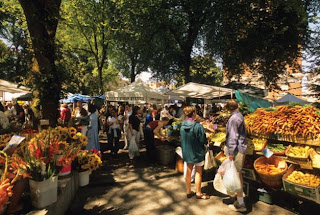
Today I went to the Portland Farmers Market. The late morning shadows filtered through the oaks and beeches, dappling the ground as we walked through the Portland State campus. Suddenly food stands arrived and clusters of people surrounded them, looking, sampling and buying.


There were purple peppers, golden cauliflowers, native oysters, chevre, pistachio pestos, elk jerkies, artisan breads, heirloom tomatoes, Jerusalem artichokes, squash, gourds, tables of chanterelles, red and yellow dahlias, dried cherries, huckleberries, ripe strawberries, jams, spicy jellies, cherry ciders, milk chocolates, honeycrisp apples, white rose peaches, and all of the transactions were cash. It was much like a medieval fair.

My mother led me to her favorite tables. We sampled the better stands, and we approvingly praised the products we didn't buy. She said, "They have the best carrots." Ed, who farms garlic, onions and what my mom calls Jimi Hendrix carrots, because they're purple and yellow, out in Joseph, Oregon, was a flabby cheeked old man. He wore plaid, wide square-lensed glasses, and a gray cowboy hat. His teeth were yellow and his jowls flapped when he spoke. He is there every Saturday. 

At the end of the strip were the food carts. Pine State Biscuits are crazy - they have perfectly non-greasy fried chicken sandwiched between two flaky crusty golden biscuits smothered in coarse yellow mustard, bread and butter pickles and honey. While I waited in line, Mom bought a couple of salsa drizzled tamales, artichoke and chicken.

But the food scene isn't the only thing going on in the P.

Last night we went to Holocene to see War Paint. With their watery indie sound, the girls were a perfect fit with the candlelit bar and $3 Rainier tall boys. The crowd had a little more trouble vibing with The Very Best. By one o clock, we were in the car bar around the corner. We drove back home on the I-5 epping with seven people in the car. After some Irish champagne for a nightcap, we smoked our farewell cigarettes and called it a night.

Thursday, September 23, 2010

My Pledge to America: LGA


Americans sit and read in post postmodernism, play with their phones, hungrily eat heavily sugared treats. Different faces and colors, hairstyles and bodies, they wait for their time to be called by the airlines. A man with a weak jaw and a heavy droopy mustache walks along. Travellers more practiced look tired, less eager than patient. Others are vaguely excited to return home or see loved ones. Business people with tans, older couples walk.

Their shoes say most. Open toed sandals, fine black leather, boat shoes, running shoes, flip flops. People walk around and sometimes you can glimpse indicators of where they're from - a Grant Park bag, an Oakland sweatshirt. It is hard to resist identifying their attire, physiognomies, and style with where they are from. Others resist identification. They are floaters or are uprooted. Ungainly, they look about, wanting to be there already. There are plans to be made with business partners and family and friends. They walk back and forth on the terminal runway.

Everyone here is relatively comfortable. They have done this before. They are familiar with the routine of travel. I am. I know the waiting, the drawn out hours of in between, the pleasure of arrival and the imminence of departure.

Tuesday, September 21, 2010

Daniel Adler Goes Home

Dear Blog Audience,
Over the next two weeks, I will be in Oregon with my crazy uncle, my granny and her small Chinese Crested Powderpuff (above). Many adventures will follow. Although I have officially spent more of my life in New York, Oregon holds a place dear in my heart. In fact, the feminine protagonist of my forthcoming novel, Hot Love on the Wing, is from Portland, because, let's face it, all fiction is at least somewhat semi-autobiographical. Here is a passage that represents the wonder of this young woman, and her home, for the lovestruck hero:


Oregon. What was it like there? Ken Kesey was from Oregon. It rained there. They had good bud. He imagined lumberjacks and wet evergreen forests, mossy with glistening raindrops on ferns and hemlock, red cedars and rolling hills. He wanted to see that wild country. His taste of grand travel while driving through Europe made him reminisce about the vast experience he still needed in order to have a grasp on the world. He desired to leave New York while he was young enough to live elsewhere, and compare it to Shanghai, Amsterdam, Los Angeles, Melbourne, Beirut, Portland - he wanted to taste the world’s full course, and he viewed his country’s west coast as a substantive appetizer.
Pardon the mise en abyme, but that was a little appetizer wasn't it? Stay tuned. 
Love,

Sunday, September 19, 2010

Stink Bugs and Apartments

The new home of Daniel Adler and family is 105 Grattan St. The area teems with young, individually minded people, and awaits imminent gentrification. Instead of the condescending, measuring looks people give when you're on Bedford Ave., the people here nod and, if you do, smile. They are locals, and because you know about this scene, they assume you are too.

Our apartment is exactly where I wanted to be. It's a quiet tree-and-brick-apartment-lined street that is in the middle of an industrial zone. There is lots of barbed wire, and caught, shredded plastic bags. Graffitti is the avant garde art, but there are a few local galleries too. Today, Roberta's had an Oktoberfest party with live music and brats.

A five step stoop leads you into the hallway and our front door, marked 1R in black lettering on gold tape. Julie will have the front well-lit room, off the cozy kitchen.  A long hallway leads past Matthew's dark middle room and through my room to the private backyard, equipped with lawn accessories (which the current tenants are kind enough to leave us). There are no stink bugs.

Julie, my cuz, was unsure at first, but one of the tenants reassured her about the neighborhood when he told her about "the best bar in America." And so the harvest begins.

Thursday, September 16, 2010

PBR: Why It Is So Loved


Pabst Blue Ribbon is one of the shitty beers Brooklyn hipsters cherish. Now don’t get me wrong, I love PBR for all its $10 hangover-inducing glory, but for around a dollar a can, there are cheaper beers out there. But PBR is the cheapest, and most widely available. That means the drunkest.

In the Oregon woods, Natty Light is common. If you're around people who know the slight differences between shitty beers, you might be offered a Keystone Light. But when I find myself with  PBR in hand, I feel like I'm sipping royally. I am a happy camper.

Coors Light is for football games with the family, Bud Light is for the Bridge and Tunnel crowd at MacFadden's. But  2 PBRs for $5 at a bar? Mowrnow. I'll take 'em.

Why is PBR so good? Well, part of it comes from the fact that it’s so damn American. They sponsor rodeos, they’re from Milwaukee, and it’s not Lite. The can is red, white and blue for chrissakes! And that golden, hoppy flavor is arguably better than Budweiser or Coors. Since it’s cheaper, it’s the obvious winner among younger folks.

Being a writer means that I have to be familiar with all of the most singular details. We can discuss cabernet sauvignon, or American lagers. Right now, it seems like the latter makes more sense. 

Tuesday, September 14, 2010

The Meaning of September: Post Postmodernism and Change


September is the most popular birthday month. Surprised? You shoudn’t be. During those cold winter holidays, everyone couples up and huddles close.
Anyway, with all these babies being born, school starting again, and the beginning of the end of the year, you may feel that vague fear that comes before impending change, especially if you’re having a baby.
That’s the beginning of a post I wrote for Net Kids Wear. The best thing about my job is the free association and philosophizing. Like most writers, I incorporate my own sentiments into a translated version of what I’m paid for. Just before Little Matthew arrived, I often felt that vague fear – like I’m overlooking a precipitous drop. Not that the vertiginous view is  negative, it just happens that when you try to look into the future, you begin to get a little woozy. Better to just let it wash over you.  
So I’ll continue to let you know how this change affects the life of Daniel Adler, in a very post postmodern (bloggy) way. In the meanwhile, read some high literature, view some avant garde art, and watch the seasons change.

Thursday, September 9, 2010

Sea of Consciousness Pt. II

Shimmer glisten sparkle.  Striated waves underneath a spectrum of blues. Plateaus of clouds and low lying moisture expand and drift like nebulae. The boat cruises on the waves and makes the magnified sound of wind blowing through reeds.

The way a small boy cries to let his older brother and his friends know they've gone too far - that waa, moving into a louder wail to show a parent that he's been hurt, and then the way he sits alone, despondently, regretfully wishing that he had been more of a man, able to withstand the pain and teasing better, that he had been born older, and not the little brother, the baby.

The sky is a spectrum, ranging from white blue at the horizon to baby at the cloudline, directly above and back the other way.

Daniel Adler thinks the the sea roils like green wine from the cask. A tender tendril of sand.

Wednesday, September 1, 2010

When Will Post Postmodernism Start Already???

 It was the best of times, it was the worst of times. Dickens’ famous first sentence still resounds so clearly because of its universality – every age can apply it to their own. But that doesn’t mean we’re all vain; it means that we all need to focus on what makes our moment special.

Jonathan Franzen has won rave reviews for his new book Freedom, inspiring a new word – Franzenfreude – to describe the feelings of anger from mass entertainment writers as they deplore his Time cover and title of “Great American Novelist.” The book came out yesterday, but it seems to be special not for what it attempts to do, but for what it does. That is, there are no attempts toward a post postmodernism, or a stylistic avant garde art as he admitted there were in The Corrections, but instead, he depicts a culture through a novelistic lens.

That doesn’t mean that avant garde art doesn’t have a place in today’s society. The reason Franzen has been so widely lauded is that he has reverted to expressing human psychology simply – the way many of the best novels do. That doesn’t mean there’s not room for innovation. And while the specialization of last decade’s novels – the delving into ethnic family histories, the intricate layers of narrative and information – was arguably the end of postmodernism, the fact that Facebook Places has just been released as a way to update your exact physical presence means that we are still in the end of that movement, according to Frederic Jameson.

Everyone is in a tizzy, but we have still yet to fully embrace a new era, at least artistically. It seems that political revolution breeds artistic revolution. Modernism took at least the first 20 years of the 20th century to begin, and was a response  to a catastrophic war. Postmodernism was a response to JFK’s assassination and the race riots of the 60’s. Let’s hope that post postmodernism, or whatever they will call it, won’t need the same kind of catalyst.